
Toxic Masculinity Workshops for Schools, Colleges, Universities and Staff Training
2020 Dreams Toxic Masculinity Workshops for Schools help young people examine the pressures placed on boys and men around strength, emotion, status, relationships, control and identity — while building healthier, more flexible ideas of masculinity.
Masculinity itself is not the problem. Confidence, ambition, resilience, leadership, competitiveness and strength can all be positive. The concern arises when boys feel there is only one acceptable way to be male: never show vulnerability, always stay in control, dominate rather than cooperate, prove status through aggression or sexual success, and treat empathy as weakness.
Our Toxic Masculinity Workshops create space to challenge those restrictive expectations without blaming boys or presenting masculinity as inherently harmful. Participants explore where ideas about being a “real man” come from, how peer groups and online influencers reinforce them, how emotional suppression can affect wellbeing and relationships, and what positive masculinity can look like in everyday life.
The workshops also connect masculinity with wider safeguarding themes including misogyny, consent, healthy relationships, sexual harassment, online influencer culture, the manosphere, boys’ mental health, homophobia, peer pressure, violence and emotional literacy.
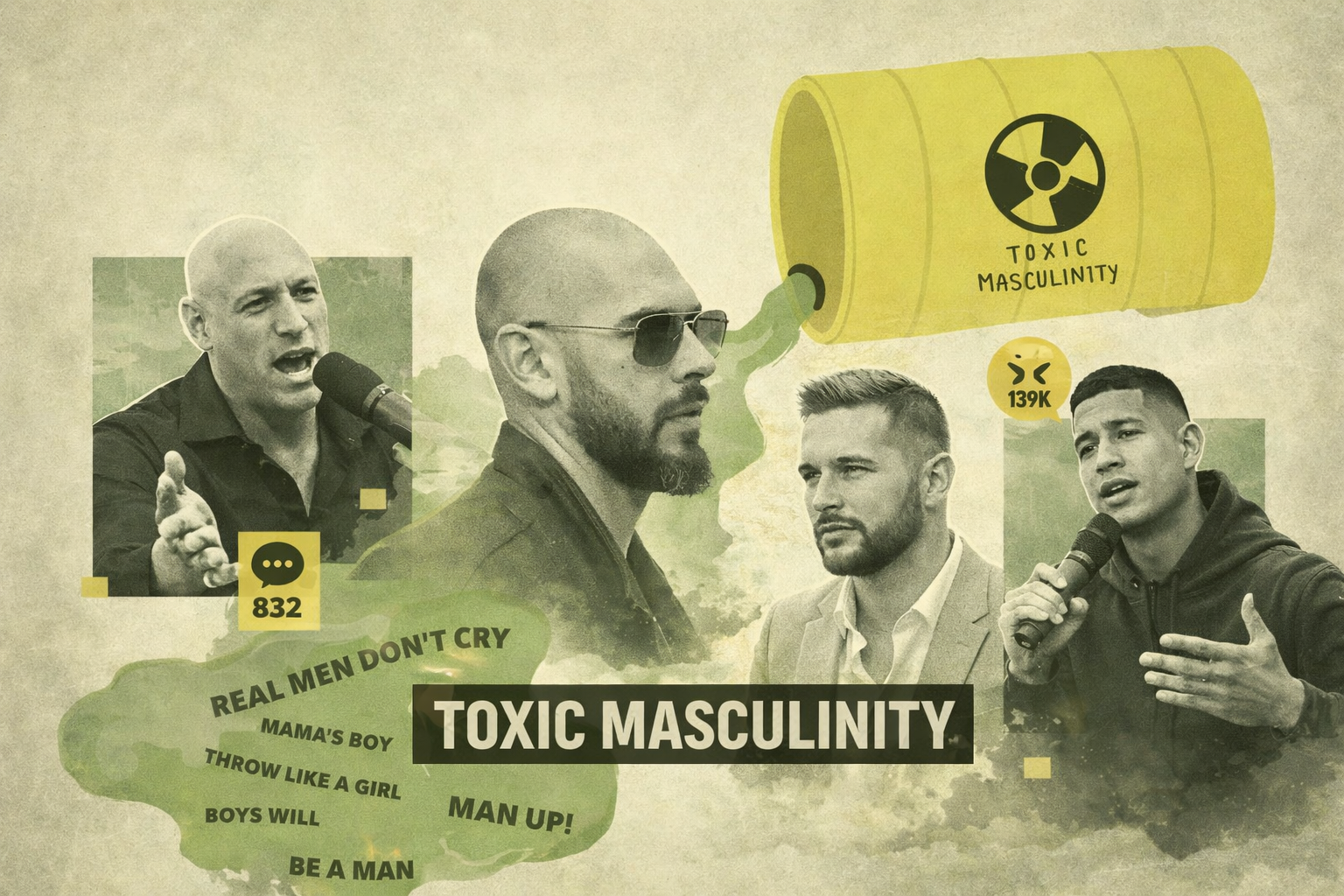
Core Features of Our Toxic Masculinity Workshops for Schools
- Balanced explanation of toxic masculinity, healthy masculinity and restrictive gender expectations
- Interactive scenarios exploring emotions, peer pressure, status, relationships, conflict and online influence
- Positive masculinity without shaming boys or stereotyping men
- Emotional literacy and practical language for expressing difficult feelings
- Critical discussion of male influencers, the manosphere and online “alpha male” culture
- Links between masculinity, misogyny, consent, sexual entitlement and healthy relationships
- Practical bystander skills for challenging harmful peer expectations safely
- Age-adapted delivery for upper primary, secondary, post-16, university, SEND, SEMH, PRUs and alternative provision
- Staff training for teachers, safeguarding leads, pastoral teams and other professionals
The objective is not to replace one rigid idea of masculinity with another. It is to give young people more choices: the confidence to speak honestly, ask for help, walk away from pressure, respect boundaries, build supportive friendships and define strength in ways that improve rather than damage their lives.
What Is Toxic Masculinity?
Toxic masculinity is a term used to describe harmful or restrictive expectations associated with masculinity — not masculinity itself. These expectations can include pressure to suppress emotion, appear constantly dominant, reject vulnerability, prove toughness, seek control over others or measure personal worth through status, aggression or sexual success.
Toxic Masculinity Workshops help pupils understand that the word “toxic” refers to the harmful effects of particular norms and behaviours, not to boys and men as a group.
A boy enjoying sport, competition, physical strength or traditionally masculine interests is not an example of toxic masculinity. The concern is when young people feel forced into behaviours that damage themselves or other people because they believe those behaviours are required to be accepted as “real men”.
This distinction is central to our approach. Effective Masculinity Workshops for Schools should challenge harmful expectations while still allowing boys to feel proud, secure and confident in their identity.
Why Schools Need Toxic Masculinity and Positive Masculinity Workshops
Boys receive messages about masculinity from many directions: family, friends, sport, entertainment, gaming, pornography, social media, influencers and wider culture. Some messages are positive. Others can suggest that emotion is weakness, asking for help is failure, aggression earns respect or control is necessary in relationships.
These pressures can affect behaviour in classrooms and corridors, but they can also affect boys internally. A young person may become skilled at appearing unaffected while struggling with rejection, anxiety, loneliness, grief, embarrassment or low self-worth.
Positive Masculinity Workshops create an opportunity to address those pressures before they become fixed habits. Students can examine what confidence really looks like, why vulnerability can require courage, how emotionally strong friendships work and why respect is compatible with ambition and leadership.
The work also benefits girls and mixed groups. Understanding the pressures boys experience can improve communication and empathy, while pupils of all genders can examine how restrictive gender expectations affect relationships, consent and peer culture.
Masculinity, Peer Pressure and Boys’ Wellbeing: What Current Evidence Shows
Current Department for Education pupil data shows that restrictive messages about masculinity remain common in schools. The figures below come from the December 2025 Parent, Pupil and Learner Voice survey, published in 2026.
Key Stage 3 pupils
Had heard comments such as “boys don’t cry”, “man up” or “boys will be boys” at school in the previous month.
Key Stage 4 pupils
Had heard the same kinds of comments from pupils at school over the previous month.
Male KS3 pupils
Agreed that boys often feel pressure not to cry, to “man up” or to misbehave.
Male KS4 pupils
Agreed that boys often experience those same pressures around emotion and behaviour.
The survey also found that around one third of male pupils said they sometimes changed their choices or behaviour to match what friends and other pupils expected from boys. This is highly relevant to Toxic Masculinity Workshops because it shows that masculinity is not simply a set of personal beliefs — it can be actively performed under peer pressure.
Online culture adds another dimension. Movember’s international research with more than 3,000 young men aged 16 to 25 found that 63% regularly watched men and masculinity influencers. The research presents a mixed picture: many young men found the content motivating, while engagement with some forms of masculinity content was also associated with poorer wellbeing and greater risk-taking. This is why our workshops teach critical evaluation rather than blanket rejection of male influencers.
What Students Learn in Toxic Masculinity Workshops
Identify messages that tell boys they must hide feelings, act tough, dominate others or prove themselves to peers.
Develop practical language for frustration, sadness, rejection, fear, embarrassment, anger and stress rather than reducing every difficult emotion to aggression or silence.
Explore courage, self-control, reliability, responsibility, empathy and asking for help as legitimate forms of strength.
Connect masculinity with communication, consent, boundaries, rejection, jealousy and healthy partnership behaviour.
Examine male influencers, algorithms and “alpha” narratives without assuming all self-improvement content is harmful.
Practise safer responses when friends reward aggression, mock vulnerability or pressure somebody to prove masculinity.
The Man Box Audit: Who Decides What a “Real Man” Should Be?
A distinctive feature of our Toxic Masculinity Workshops is the Man Box Audit. Participants examine unwritten rules they may have heard about being male and decide whether those rules build confidence or restrict it.
EMOTIONS
“Don’t cry.” “Get over it.” “Nobody cares how you feel.”
Audit question: Does hiding every difficult emotion make somebody stronger, or simply make it harder to deal with what they are experiencing?
STATUS
“A successful man must have money, muscles, attention and influence.”
Audit question: Who set that standard, and what happens when someone’s self-worth depends entirely on comparison?
CONTROL
“Never back down.” “Always be in charge.” “Respect means people fear you.”
Audit question: Is controlling other people evidence of strength, or can genuine confidence survive disagreement and boundaries?
RELATIONSHIPS
“Men shouldn’t need anyone.” “Being rejected is humiliating.” “Your partner should prove loyalty.”
Audit question: What do healthy male friendships and relationships look like when trust replaces control?
The activity allows pupils to challenge expectations without being told there is one correct personality for boys. Students can keep the parts of masculinity that strengthen them and reject rules that reduce empathy, wellbeing or freedom of choice.
Masculinity Pressure Lab: What Would You Do?
The Pressure Lab turns theory into realistic decision making. Pupils explore situations in which masculine expectations are enforced by peers rather than by formal rules.
A Friend Is Struggling
A boy tells his friends he is overwhelmed and one person laughs and tells him to “man up”.
Workshop question: How could somebody support him without making him feel exposed or embarrassed?
The Public Challenge
A disagreement is escalating and friends say walking away would make somebody look weak.
Workshop question: Which requires more self-control: reacting for the audience or choosing the outcome you actually want?
The Relationship Test
A young man is told that jealousy and checking a partner’s phone prove that he cares.
Workshop question: When does insecurity become control, and what would confidence look like instead?
The Online Role Model
An influencer says successful men never show weakness and should dominate relationships.
Workshop question: Is this building confidence or creating a permanent performance that nobody can realistically maintain?
What Our Toxic Masculinity Workshops Cover
Every Toxic Masculinity Workshop is tailored around age, setting and safeguarding priorities. Programmes can provide broad healthy-masculinity education or focus more deeply on emotional literacy, misogyny, the manosphere, peer pressure, relationships, violence, boys’ wellbeing or staff training.
Healthy Masculinity vs Restrictive Masculinity
Students explore the difference between masculine identity and harmful expectations that restrict behaviour.
🔹 Confidence versus domination
🔹 Strength versus aggression
🔹 Leadership versus control
🔹 Independence versus isolation
🔹 Resilience versus emotional shutdown
🔹 Competition versus humiliation
🔹 Pride versus entitlement
🔹 Healthy masculinity as choice rather than performance
Emotional Suppression, Anger and Boys’ Mental Health
Emotional Literacy Workshops for Boys can form a major part of the programme. Students explore why anger is often easier to express publicly than sadness, fear, rejection or embarrassment.
🔹 Naming emotions accurately
🔹 Recognising stress before overload
🔹 Rejection, humiliation and anger
🔹 Grief and loss
🔹 Healthy ways to ask for help
🔹 Supporting male friends
🔹 Emotional regulation without shame
🔹 Understanding that emotional control is different from emotional suppression
Peer Pressure, Status and Proving Masculinity
Boys may perform masculinity for other boys as much as for girls. Workshops explore the social reward systems that can make risky behaviour feel necessary.
🔹 Fear of looking weak
🔹 Group approval
🔹 “Banter” and humiliation
🔹 Fighting and public challenges
🔹 Sexual reputation
🔹 Body image and physical status
🔹 Risk-taking to impress peers
🔹 Confidence to disengage from an audience
Toxic Masculinity, Misogyny and Sexism
Restrictive masculinity does not automatically produce misogyny, but particular ideas about dominance, entitlement and gender hierarchy can contribute to harmful attitudes towards women and girls.
🔹 Sexist language
🔹 Gender stereotypes
🔹 Entitlement
🔹 Objectification
🔹 Victim blaming
🔹 Hostility to equality
🔹 Respectful disagreement
🔹 Accountability without shame
For a dedicated gender-attitudes programme, see our Misogyny Workshops.
The Manosphere, Male Influencers and Online “Alpha” Culture
Online content about masculinity can offer motivation, fitness advice, financial guidance and community. Workshops teach pupils to keep useful ideas while questioning messages built on misogyny, domination, grievance or unrealistic status expectations.
🔹 Male influencers and online gurus
🔹 “Alpha male” narratives
🔹 Wealth and status as proof of worth
🔹 Fitness and body-image pressure
🔹 Online misogyny
🔹 Algorithms and echo chambers
🔹 Influencer monetisation
🔹 Critical thinking and healthy role models
For deeper exploration of online male culture, see our Manosphere Workshops.
Consent, Rejection and Healthy Relationships
The way boys understand masculinity can influence dating and relationships. Workshops examine whether confidence is based on communication and mutual respect or on control and entitlement.
🔹 Consent and ongoing communication
🔹 Accepting rejection
🔹 Jealousy and insecurity
🔹 Possessiveness
🔹 Password and location demands
🔹 Emotional manipulation
🔹 Respectful disagreement
🔹 Equality within relationships
This content connects directly with our Healthy Relationships Workshops, which build the practical relationship skills that positive masculinity should support: respect, trust, communication, equality, boundaries and healthy conflict. It can also be combined with our dedicated Consent Workshops. Where discussion moves into sexualised comments, unwanted attention, sexual entitlement or peer harassment, the programme can also link directly to our Sexual Harassment Workshops.
Masculinity, Aggression, Violence and Personal Safety
Some boys experience strong social pressure to retaliate, never back down or use aggression to protect reputation. Workshops examine the consequences of performing toughness when a safer choice is available.
🔹 Conflict and reputation
🔹 Retaliation
🔹 Anger and impulse
🔹 Group pressure
🔹 Walking away without shame
🔹 Self-control as strength
🔹 Bystander responsibility
🔹 Seeking help when threats are serious
Where weapon carrying or serious youth violence is a specific concern, this can be combined with our Knife Crime Workshops.
Homophobia, Gender Policing and Fear of Appearing “Unmanly”
Rigid masculinity can be enforced by mocking boys whose interests, appearance, friendships or emotional expression do not fit expected stereotypes.
🔹 Gender policing between peers
🔹 Homophobic language
🔹 Fear of being judged
🔹 Stereotypes about hobbies and appearance
🔹 Respecting different ways of being male
🔹 Inclusive friendship groups
🔹 Confidence without conformity
Positive Male Role Models and Healthy Masculinity
Positive Masculinity Workshops work best when young people are offered alternatives rather than only being told what not to do.
🔹 Emotional courage
🔹 Reliability and responsibility
🔹 Respect for boundaries
🔹 Positive leadership
🔹 Supportive male friendship
🔹 Healthy competition
🔹 Asking for help
🔹 Ambition without devaluing others
🔹 Strength that includes empathy and self-control
From Pressure to Harm: The Masculinity Performance Pathway
The Masculinity Performance Pathway helps pupils understand how social expectations can affect behaviour without suggesting that the outcome is inevitable.
EXPECTATION
A boy receives messages about how a “real man” should look, feel, behave or respond.
PERFORM
Behaviour changes to gain approval: acting tougher, taking risks, hiding emotion or exaggerating confidence.
SUPPRESS
Feelings, uncertainty or vulnerability are pushed down because expressing them seems socially unsafe.
CONSEQUENCE
The pressure can contribute to isolation, conflict, risky behaviour, poor communication or unhealthy relationships.
Prevention means interrupting the pathway early. A pupil who recognises the pressure has more freedom to decide whether the expectation is useful or whether it is making choices on their behalf.
The 2020 Dreams REAL Strength Framework
Our REAL Strength Framework gives students a positive alternative to restrictive masculinity. Instead of defining manhood through appearance or status, the framework focuses on choices and character.
RECOGNISE
Notice when pressure, pride, insecurity or an audience is influencing a decision.
EXPRESS
Use language for emotion, ask for help and communicate rather than hiding everything until it becomes anger.
ACT
Choose behaviour based on respect, self-control and the outcome you want rather than what proves toughness.
LEAD
Make it easier for friends to be honest, respectful and themselves instead of rewarding harmful peer pressure.
Toxic Masculinity Workshop Overview
Toxic Masculinity Workshops and the 2026 RSHE Requirements
The revised statutory Relationships, Sex and Health Education guidance is for introduction on 1 September 2026. It strengthens teaching around harmful misogynistic online content, the manosphere, positive male role models, consent, power and control, pornography, incel culture, AI and deepfakes.
The Department for Education has specifically emphasised the importance of helping boys identify positive role models and challenge harmful myths without stigmatising boys for being boys.
The government’s current Violence Against Women and Girls strategy similarly states that schools should support young people to develop positive conceptions of masculinity and femininity and understand the harmful impact of misogynistic online content.
Curriculum support: Toxic Masculinity Workshops can support these priorities through emotional literacy, positive masculinity, relationships education, influencer awareness and discussion of harmful gender expectations. External workshops support rather than replace a school’s planned RSHE curriculum and safeguarding procedures.

Video: Toxic Masculinity Workshops in Practice
Interactive delivery is central to the programme. Students are encouraged to discuss, question and test ideas rather than simply listen to a presentation.
Toxic Masculinity Staff Training for Schools and Professionals
Alongside pupil sessions, Toxic Masculinity Staff Training is available for teachers, designated safeguarding leads, pastoral teams, senior leaders, youth workers, social care professionals and other organisations working with young people.
Staff training can focus on:
🔹 Understanding toxic, restrictive and positive masculinity
🔹 Recognising peer pressure and gender policing
🔹 Boys’ emotional literacy and help-seeking
🔹 Misogyny, sexism and gendered harassment
🔹 The manosphere and online male influencers
🔹 Supporting boys without shame or confrontation
🔹 Healthy relationships, consent and entitlement
🔹 Responding to sexist or homophobic language
🔹 Aggression, conflict and reputation
🔹 Positive male role modelling
🔹 Embedding 2026 RSHE priorities into curriculum and pastoral practice
Training can be delivered as a standalone CPD session or incorporated into a wider Staff Training.
Safeguarding and Wellbeing Outcomes
Well-designed Toxic Masculinity Workshops can strengthen safeguarding and wellbeing by giving pupils and staff a shared language for discussing masculinity pressure, emotion, peer expectations, relationships and online influence.
The programme can help boys recognise that asking for help does not reduce their masculinity and that anger is not the only socially acceptable response to a difficult experience. It can also help peers notice when joking or pressure is making it harder for somebody to be honest.
For girls and mixed groups, the programme offers a way to understand how restrictive masculinity can affect relationships and peer culture without excusing harmful behaviour. Empathy and accountability are presented together.
Toxic Masculinity Workshops by Age Group
Content is adapted by age, maturity and setting. The same language and examples are not used across every phase.
Healthy Masculinity Workshops for Upper Primary, Years 5 and 6
Upper-primary delivery focuses on emotions, friendship, stereotypes, kindness, confidence and the idea that boys and girls should not be restricted by narrow expectations.
Aims: emotional vocabulary, respectful friendship, challenging “boys don’t cry” stereotypes, empathy and preparation for secondary school.
Toxic Masculinity Workshops for Secondary Schools, KS3 and KS4
Secondary sessions explore peer pressure, status, emotional suppression, aggression, misogyny, influencers, the manosphere, consent, relationships, rejection and healthy masculinity.
Aims: emotional literacy, critical thinking, respectful relationships, positive masculinity and stronger decision making under peer pressure.
Positive Masculinity Workshops for Sixth Forms and Colleges
Post-16 sessions can explore adult relationships, pornography, nightlife, sexual reputation, social media, body image, money, career pressure, rejection and the transition into adult male identity.
Aims: mature emotional intelligence, healthy relationships, digital literacy, confidence and responsibility.
Masculinity Workshops for Universities and Adult Learners
University programmes can support Freshers Week, student wellbeing, consent campaigns, sports teams, equality initiatives and wider work around male identity, relationships and campus culture.
Aims: emotional wellbeing, consent, respectful culture, positive masculinity, bystander responsibility and professional conduct.
Toxic Masculinity Workshops for SEND, SEMH, PRUs and Alternative Provision
The programme can be adapted for SEND, SEMH, PRUs and alternative provision using shorter activities, clearer language, visual prompts and more concrete scenarios.
For some young people, social rules around masculinity can be especially confusing or intensely enforced by peers. Sessions can therefore focus on recognising pressure, naming emotion, responding to teasing, safe conflict choices and identifying trusted support.
Benefits of Toxic Masculinity and Positive Masculinity Workshops
Acknowledges genuine pressures around masculinity while challenging harmful responses to those pressures.
Gives boys practical vocabulary and strategies for communicating difficult feelings before they become withdrawal or anger.
Helps pupils recognise when an audience, friendship group or stereotype is deciding how they behave.
Connects confidence with consent, communication, rejection, boundaries and respect rather than control.
Allows young people to question masculinity influencers without dismissing all male-focused or self-improvement content.
Provides practical education around positive male role models, harmful gender attitudes, misogynistic online content and healthy relationships.
What Schools and Organisations Say
“2020 Dreams delivered a Toxic Masculinity workshop for our Year 10 and Year 11 boys, which was highly engaging and well-structured. The facilitator used an effective icebreaker to build rapport before introducing the PSHE content, encouraging strong student interaction throughout. Feedback from pupils was excellent.”
B. Wilson, Appleford School
“The Toxic Masculinity training was an excellent session that opened up important discussions. I found it engaging and relevant, and it highlighted why this topic needs to be addressed within the workplace.”
N. Pendry, Milton Keynes City Council
“Just want to say a massive thank you for making SMSC day happen. The feedback I got was amazing. As a result, I would certainly be interested in acquiring your services again in the near future.”
C. Walters, Holte School
“Thank you for providing the Gender Equality and Misogyny Workshops. All the workshops went well. The students enjoyed their sessions and we look forward to working with you again.”
L. Sherman, Head of PSHE, Aldenham School
How We Deliver Toxic Masculinity Workshops
Facilitators create structured conversation rather than simply presenting pupils with a list of behaviours they should avoid.
Pupils examine common unwritten rules about emotion, status, control and relationships and decide whether those rules strengthen or restrict them.
Realistic scenarios explore peer approval, vulnerability, conflict, jealousy and online role models.
Students are given healthier alternatives around confidence, ambition, emotion, relationships and male friendship rather than being shamed.
Content is adapted to age group, setting, gender mix, safeguarding priorities and specific concerns identified by the organisation.
Assemblies, one-hour workshops, extended sessions, half-day programmes, full-day programmes, boys-only groups, mixed groups and staff CPD.
Face-to-face delivery across the UK with virtual options for UK and international organisations.
Related Masculinity, Relationships and Safeguarding Workshops
Toxic masculinity can overlap with online influence, misogyny, relationships, mental health and violence. Build a wider programme with related 2020 Dreams sessions.
Consent, unwanted sexual behaviour, sexual violence, online harassment, bystander skills, image-based abuse and safeguarding.
Male influencers, online masculinity, incel culture, algorithms, grievance and digital literacy.
Sexism, gender attitudes, influencers, harassment, entitlement and safeguarding.
Communication, boundaries, respect, red flags, equality and emotional health.
Consent, rejection, pressure, communication, boundaries and respectful relationships.
Violence against women and girls, harassment, coercive control and prevention.
Fear, reputation, retaliation, weapon carrying, peer pressure and safer decisions.
Toxic Masculinity Workshops FAQ
Book Toxic Masculinity Workshops for Your School or Organisation
Ready to bring Toxic Masculinity Workshops to your school, college, university or organisation? Tell us the age group, number of participants, preferred dates, location and the masculinity, wellbeing or safeguarding concerns you would most like the session to address.
We can deliver a standalone Toxic Masculinity Workshop or build a wider programme combining positive masculinity with misogyny, the manosphere, consent, healthy relationships, VAWG, online safety and mental wellbeing.
You may also like…
Toxic Masculinity, Positive Masculinity and Boys’ Wellbeing References
Our Toxic Masculinity Workshops draw on current statutory guidance and research into masculinity stereotypes, boys’ wellbeing, male influencers and online culture:
- Department for Education – Relationships Education, RSE and Health Education Statutory Guidance – revised statutory guidance for introduction on 1 September 2026, including content on positive male role models, the manosphere, misogynistic online influences, consent, pornography, AI and deepfakes.
- Department for Education – Misogynistic Myths Kicked Out of Classrooms – government summary of the 2026 RSHE changes, including the commitment to challenge harmful online myths without stigmatising boys.
- Department for Education – Parent, Pupil and Learner Voice: December 2025 – pupil survey data on “man up” stereotypes, pressure on boys, peer expectations and misogynistic comments.
- Movember Institute – Young Men’s Health in a Digital World – research with more than 3,000 young men aged 16 to 25 across the UK, US and Australia on masculinity influencers, mental wellbeing and gender attitudes.
- UCL – Social Media Algorithms Amplify Misogynistic Content to Teens – research examining algorithmic amplification, self-improvement content and the movement towards misogynistic recommendations.
- Home Office – Freedom from Violence and Abuse: Cross-Government VAWG Strategy – current strategy supporting positive conceptions of masculinity and femininity and education around harmful misogynistic online content.
- London City Hall – Talking to Young Men and Boys About the Manosphere – 2026 guidance for parents, carers, educators and youth workers on constructive conversations with boys about online male-focused content.
- Department for Education – Keeping Children Safe in Education 2026 – statutory safeguarding guidance for schools and colleges coming into force on 1 September 2026.
These sources inform our current, balanced and safeguarding-focused approach. The goal is not to define one “correct” way to be male, but to help young people recognise restrictive pressures and build healthier, respectful choices.